Kubectl Deep Dive - Admission Granted
Welcome back to the Kubectl Deep Dive (KUDD). In KUDD #01 we built a local KinD lab 🧪, and in KUDD #02 we stopped treating kubectl like magic and called the API server directly 🌐. Today we walk through the gate 🚪. Admission control is the part of the API request processing (after authentication and authorization) that gets to change or reject every object on its way into the cluster, and as of Kubernetes 1.36 there is a brand new, much lighter way to do declarative mutation that lives entirely inside the API server itself 🆕.
“The cheapest, fastest, and most reliable components of a computer system are those that aren’t there.” ~ Gordon Bell
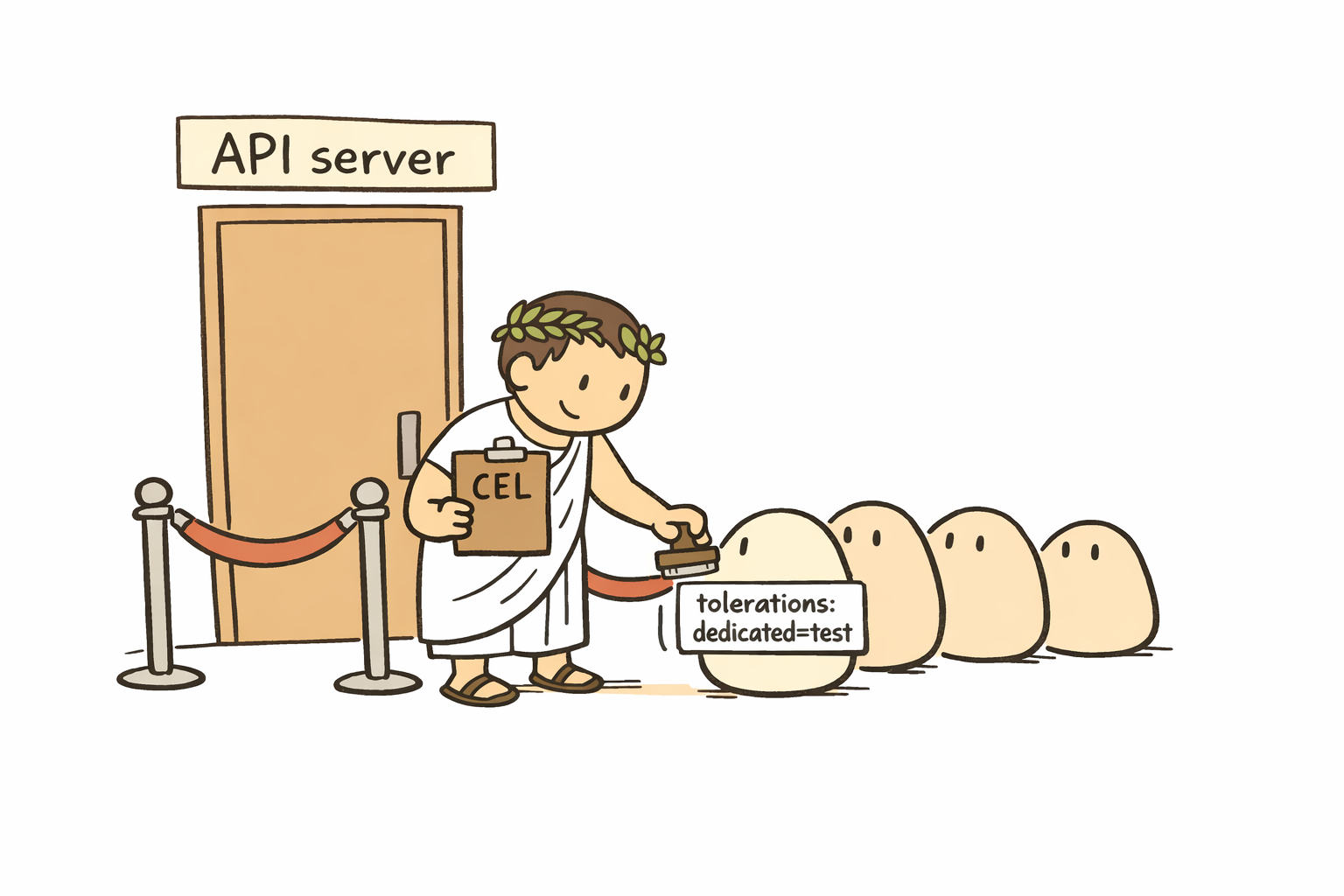
Let me start with a real-world story. On a recent project I had an end-to-end test suite running on an EKS cluster with several node groups. I wanted the test pods to land on a dedicated test node group with a dedicated=test:NoSchedule taint, so the test pods don’t interfere with regular traffic. The pods were created through an upstream API that I didn’t own, and it didn’t surface a way to set node affinity or tolerations on the pod spec. So, I wrote a mutating admission webhook plus a small Go server, registered it with the cluster, signed a cert, and hooked up monitoring. The admission webhook intercepted the test pods and injected the node affinity and toleration for the test node group. So, the test pods and only the test pods were scheduled on the dedicated test node group. It worked. It was an idiomatic Kubernetes solution. But, it was also a whole new workload to babysit just to add a couple of fields to the spec of some test pods.
Unfortunately, AWS EKS supports only Kubernetes 1.35 at the time of writing. If our Kubernetes cluster had been on 1.36, the entire thing would have been a couple of Kubernetes objects. Let’s walk through why.
🚧 The Problem 🚧
To turn the real-world setup into a KinD lab, we need a small cluster with a dedicated “test” node we can taint. Here is the config:
# kind-admission.yaml
kind: Cluster
apiVersion: kind.x-k8s.io/v1alpha4
name: admission
nodes:
  - role: control-plane
  - role: worker
  - role: worker
  - role: worker
    labels:
      dedicated: test
One twist: as of this writing there is no pre-built kindest/node:v1.36.0 image yet on Docker Hub. Kubernetes 1.36 shipped on April 22, 2026 and the kind image build typically lags the upstream release by a few weeks. Until it lands, you have to build the image yourself from the release artifacts:
kind build node-image --type release v1.36.0 --image kindest/node:v1.36.0
The --type release mode pulls the pre-built Kubernetes binaries (no compile from source needed) and packages them into a node image. It takes a couple of minutes. Then create the cluster pointed at it:
kind create cluster --config kind-admission.yaml --image kindest/node:v1.36.0
Verify we are on 1.36 and have four nodes:
$ kubectl version
Client Version: v1.36.1
Kustomize Version: v5.8.1
Server Version: v1.36.0

$ kubectl get nodes
NAME                      STATUS   ROLES           AGE     VERSION
admission-control-plane   Ready    control-plane   9m51s   v1.36.0
admission-worker          Ready    <none>          9m37s   v1.36.0
admission-worker2         Ready    <none>          9m37s   v1.36.0
admission-worker3         Ready    <none>          9m37s   v1.36.0
Taint admission-worker3 so nothing schedules there without a matching toleration:
$ kubectl taint node admission-worker3 dedicated=test:NoSchedule
node/admission-worker3 tainted

$ kubectl get nodes -o jsonpath='{range .items[*]}{.metadata.name}{"\t"}{.spec.taints}{"\n"}{end}'
admission-control-plane  [{"effect":"NoSchedule","key":"node-role.kubernetes.io/control-plane"}]
admission-worker
admission-worker2
admission-worker3        [{"effect":"NoSchedule","key":"dedicated","value":"test"}]
Let’s create a “test pod” labeled role=e2e-test, but with no tolerations and no nodeSelector. That is the scenario: the create-time API does not let us add tolerations.
$ kubectl run e2e-1 --image=busybox --labels=role=e2e-test -- sleep 3600
pod/e2e-1 created

$ kubectl get pod e2e-1 -o wide
NAME    READY   STATUS    RESTARTS   AGE   IP           NODE
e2e-1   1/1     Running   0          3s    10.244.3.5   admission-worker2
The pod ran fine, but it landed on admission-worker2. The kube-scheduler will never put it on admission-worker3 because there is no toleration for the dedicated=test:NoSchedule taint, and nothing tells it to prefer the test node either. Functionally we have an e2e test running on the same nodes as our regular traffic. We need a mutator to inject both a toleration and a nodeSelector between the API client and persistence in etcd.
🚪 What is Admission Control 🚪
Quick refresher. Every write to the Kubernetes API server runs through a fixed pipeline. From the API server’s point of view, a POST /api/v1/namespaces/default/pods request does roughly this:
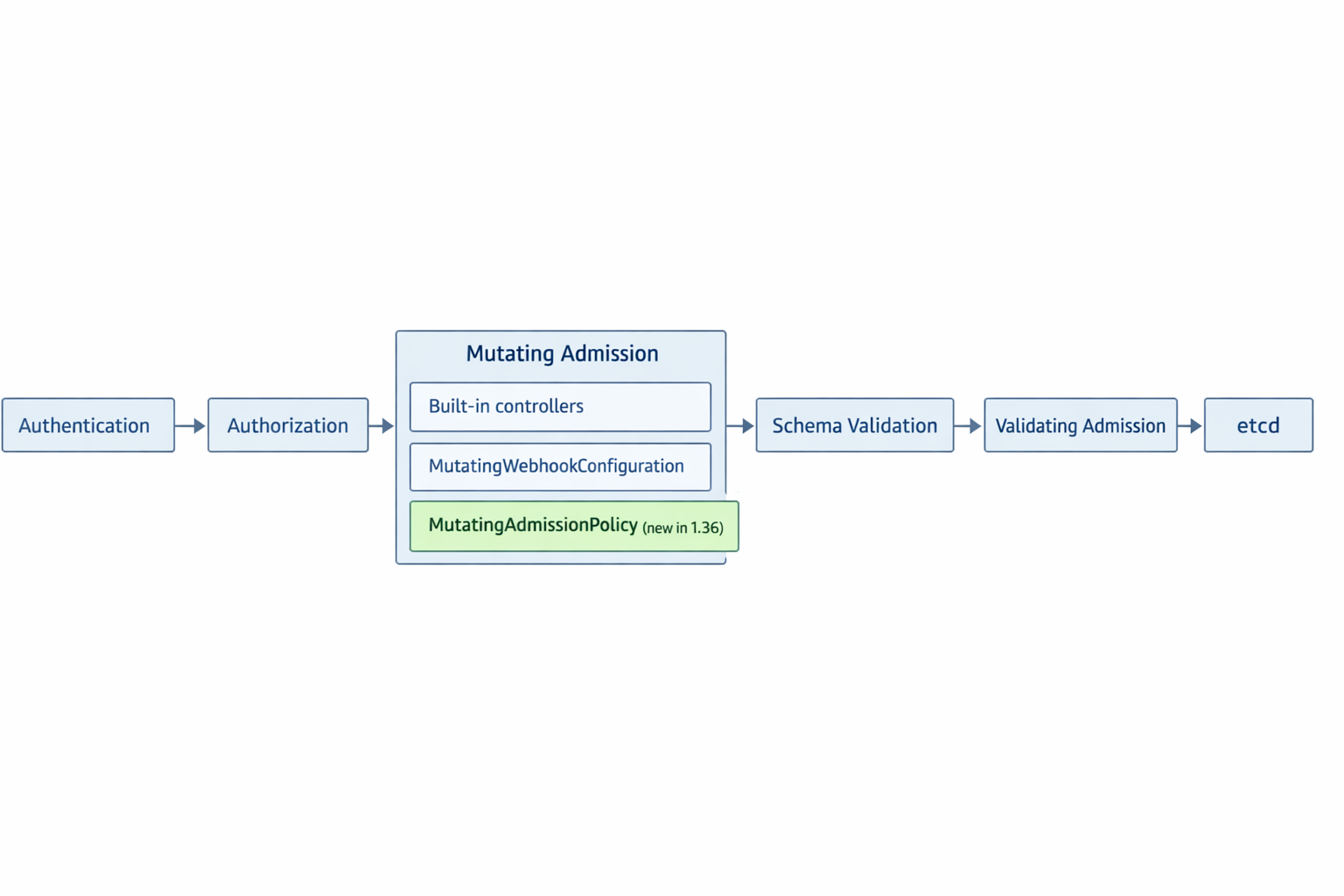
The mutating admission step is the only one that can change the incoming object. Built-in mutating controllers (the ServiceAccount admission plugin, DefaultStorageClass, DefaultTolerationSeconds, etc.) live in this stage and are compiled into the API server. External logic plugs in via MutatingWebhookConfiguration, which registers a remote HTTPS endpoint the API server calls during admission. Kubernetes 1.36 adds a third option in that lane: MutatingAdmissionPolicy, evaluated by the API server itself using CEL.
We have three real options for our toleration-injection problem. Let’s look at each one.
🏗️ Option A: Roll Your Own Webhook 🏗️
This is what we did at work. The webhook side of it is a few small pieces. You write an HTTPS server (in Go, but anything works) that accepts an AdmissionReview POST, makes a mutation decision, and returns an AdmissionReview response with a patch field containing a JSON Patch. You ship that server as a Deployment, expose it via a Service, and tell the API server about it with a MutatingWebhookConfiguration that names the resources to intercept and the URL to call. The handler is small. The supporting plumbing is not.
The registration object looks like this:
apiVersion: admissionregistration.k8s.io/v1
kind: MutatingWebhookConfiguration
metadata:
  name: add-test-tolerations
webhooks:
  - name: add-test-tolerations.gigi.zone
    clientConfig:
      service:
        namespace: admission-system
        name: toleration-injector
        path: /mutate
      caBundle: <base64 CA cert>
    rules:
      - apiGroups:   [""]
        apiVersions: ["v1"]
        operations:  ["CREATE"]
        resources:   ["pods"]
    admissionReviewVersions: ["v1"]
    sideEffects: None
    failurePolicy: Fail
And on the server side, the core of the handler is just “decode the AdmissionReview, build a JSON Patch, encode the response”:
func mutate(w http.ResponseWriter, r *http.Request) {
    var review admissionv1.AdmissionReview
    json.NewDecoder(r.Body).Decode(&review)
    patch := []map[string]any{
        {"op": "add", "path": "/spec/tolerations", "value": []map[string]any{{
            "key": "dedicated", "operator": "Equal",
            "value": "test", "effect": "NoSchedule",
        }}},
        {"op": "add", "path": "/spec/nodeSelector", "value": map[string]string{
            "dedicated": "test"}},
    }
    // ... encode review.Response with the patch ...
}
That handler is maybe 30 lines including JSON encoding. The handler is not the problem.
It works like a charm. The problem is that you now have a whole new workload to manage. Cert rotation is on you. RBAC for the webhook to do anything beyond admission is on you. Availability is on you, and the bar is high: failurePolicy: Fail means a flaky webhook breaks pod creation cluster-wide, while failurePolicy: Ignore means mutations silently skip during incidents. Monitoring is on you. Version skew with the Kubernetes API is on you. Image builds, image scanning, deployment to all environments, e2e tests, all on you. For a single mutation rule, that is a lot.
It was the right call when we did it. It would not be the right call for long.
🧰 Option B: Pull in Kyverno 🧰
Kyverno is a popular, mature Kubernetes-native policy engine. It can mutate, validate, generate, verify images, emit policy reports, and a lot more. The community is huge and the policy library is great. I’m a big fan of Kyverno, and I’ve used successfully in production to control tens of Kubernetes clusters. For our problem the incantation is short:
apiVersion: kyverno.io/v1
kind: ClusterPolicy
metadata:
  name: add-test-tolerations
spec:
  rules:
    - name: add-test-tolerations
      match:
        any:
          - resources:
              kinds: [Pod]
              selector:
                matchLabels:
                  role: e2e-test
      mutate:
        patchStrategicMerge:
          spec:
            tolerations:
              - key: dedicated
                operator: Equal
                value: test
                effect: NoSchedule
            nodeSelector:
              dedicated: test
That is readable, declarative, and lives in the cluster as a regular object. So far so good.
The catch is that Kyverno is itself a beast. You install a helm chart that brings several pods (the admission webhook server, the background controller, the cleanup controller, the reports controller), its own CRDs, leader election, RBAC, upgrades, and the operational story that goes with all of it. If you have many policies, want validation and mutation and image verification and policy reports under one roof, want background scans, want policy exceptions as first-class objects, all of that is exactly what you are buying. If your single mutation need is “inject these tolerations on e2e test pods” then Kyverno is a huge overkill.
✨ Option C: MutatingAdmissionPolicy (1.36 GA) ✨
The new option from 1.36 is built into the API server. No webhook server, no controller, no certs, no Deployment, no Service. You define two objects and the API server takes it from there.
The two objects are:
MutatingAdmissionPolicy: the rule. What to match and what to mutate, expressed in CEL.MutatingAdmissionPolicyBinding: the scope. Which namespaces and objects this rule applies to. A single policy can have multiple bindings, which is the parametrization story.
Confirm 1.36 promoted them to v1:
$ kubectl api-resources --api-group=admissionregistration.k8s.io
NAME                                SHORTNAMES   APIVERSION                        NAMESPACED   KIND
mutatingadmissionpolicies                        admissionregistration.k8s.io/v1   false        MutatingAdmissionPolicy
mutatingadmissionpolicybindings                  admissionregistration.k8s.io/v1   false        MutatingAdmissionPolicyBinding
mutatingwebhookconfigurations                    admissionregistration.k8s.io/v1   false        MutatingWebhookConfiguration
validatingadmissionpolicies                      admissionregistration.k8s.io/v1   false        ValidatingAdmissionPolicy
validatingadmissionpolicybindings                admissionregistration.k8s.io/v1   false        ValidatingAdmissionPolicyBinding
validatingwebhookconfigurations                  admissionregistration.k8s.io/v1   false        ValidatingWebhookConfiguration
GA at v1. On 1.34 and 1.35 the same shape lives at admissionregistration.k8s.io/v1beta1 (you have to update the apiVersion). The spec body is the same.
Here is the policy plus binding that does our toleration injection:
apiVersion: admissionregistration.k8s.io/v1
kind: MutatingAdmissionPolicy
metadata:
  name: add-test-tolerations.gigi.zone
spec:
  matchConstraints:
    resourceRules:
      - apiGroups:   [""]
        apiVersions: ["v1"]
        operations:  ["CREATE"]
        resources:   ["pods"]
  matchConditions:
    - name: only-e2e-test-pods
      expression: "has(object.metadata.labels) && 'role' in object.metadata.labels && object.metadata.labels['role'] == 'e2e-test'"
  failurePolicy: Fail
  reinvocationPolicy: Never
  mutations:
    - patchType: JSONPatch
      jsonPatch:
        expression: |
          [
            JSONPatch{
              op: "add",
              path: "/spec/tolerations",
              value: dyn([])
            },
            JSONPatch{
              op: "add",
              path: "/spec/tolerations/-",
              value: Object.spec.tolerations{
                key: "dedicated",
                operator: "Equal",
                value: "test",
                effect: "NoSchedule"
              }
            },
            JSONPatch{
              op: "add",
              path: "/spec/nodeSelector",
              value: Object.spec.nodeSelector{dedicated: "test"}
            }
          ]
---
apiVersion: admissionregistration.k8s.io/v1
kind: MutatingAdmissionPolicyBinding
metadata:
  name: add-test-tolerations-binding
spec:
  policyName: add-test-tolerations.gigi.zone
  matchResources: {}
Let’s explore a bit. matchConstraints is the broad filter: which API resources are even candidates. matchConditions is the per-request filter expressed in CEL. Here we look at the incoming object’s labels and only act on pods labeled role=e2e-test. failurePolicy: Fail mirrors the webhook field: if CEL evaluation errors out, reject the request. reinvocationPolicy: Never says “do not call us again after other mutations run”.
The interesting part is mutations. We use patchType: JSONPatch because the things we want to set, tolerations and nodeSelector, are atomic in the Kubernetes schema, and the alternative ApplyConfiguration strategy refuses to touch atomic arrays and maps (sensible default, since SSA would happily delete entries on a mismatch). JSONPatch is more surgical and works fine here.
The expression returns a list of JSONPatch values. Three patches:
- The first creates
spec.tolerationsas an empty array. New pods coming through the API do not have the field set until theDefaultTolerationSecondsplugin runs later in the chain, so we make sure the path exists before we append to it. Thedyn([])cast is a small CEL nudge: it tells the type checker “treat this empty list as a dynamic value” so it lines up withJSONPatch.value’s any-type slot. - The second appends our toleration using the
-index, which means “append to array”. The value uses CEL’s typed object constructorObject.spec.tolerations{...}, which produces a properly shapedTolerationobject that the API server can serialize back to JSON. - The third sets
spec.nodeSelectorto a single-entry map, again using the typed constructorObject.spec.nodeSelector{...}.
The binding is small. policyName points at the policy. matchResources: {} says “everywhere this policy could match” (we already narrowed via the policy’s matchConstraints and matchConditions). In real life this is where you would scope to a namespace selector, or to a labeled subset of objects, so the same policy can be reused across environments by binding it differently.
CEL deserves one quick paragraph. It is the same expression language used by validating admission policies, the kubelet’s pod admission, and authorization webhook policies. It is intentionally not Turing-complete, has bounded evaluation cost, and is not allowed to make external calls. That last constraint is the whole point. The API server can evaluate the expression in-process, fast and predictably, with no separate workload to keep alive. The webhook server we would have run just disappears.
Let’s apply the policy:
$ kubectl apply -f policy.yaml
mutatingadmissionpolicy.admissionregistration.k8s.io/add-test-tolerations.gigi.zone created
mutatingadmissionpolicybinding.admissionregistration.k8s.io/add-test-tolerations-binding created
Wait a few seconds for the API server’s policy cache to refresh, then create a new test pod:
$ kubectl run e2e-2 --image=busybox --labels=role=e2e-test -- sleep 3600
pod/e2e-2 created

$ kubectl get pod e2e-2 -o wide
NAME    READY   STATUS    RESTARTS   AGE   IP           NODE
e2e-2   1/1     Running   0          3s    10.244.1.3   admission-worker3
Yeah, it works! The pod was scheduled on the tainted admission-worker3.
🔬 Watching it Happen 🔬
But, maybe the scheduler just got lucky? Pull the pod’s spec and look:
$ kubectl get pod e2e-2 -o jsonpath='nodeSelector: {.spec.nodeSelector}{"\n"}tolerations: {.spec.tolerations}{"\n"}'
nodeSelector: {"dedicated":"test"}
tolerations: [{"effect":"NoSchedule","key":"dedicated","operator":"Equal","value":"test"},{"effect":"NoExecute","key":"node.kubernetes.io/not-ready","operator":"Exists","tolerationSeconds":300},{"effect":"NoExecute","key":"node.kubernetes.io/unreachable","operator":"Exists","tolerationSeconds":300}]
Both fields are there, and the user’s manifest never mentioned either. The first toleration in the list is ours. The other two are the standard not-ready and unreachable tolerations that DefaultTolerationSeconds adds later in the pipeline. Notice how cleanly the two stages compose: our policy ran before DefaultTolerationSeconds, ours initialized the array and appended one entry, and the built-in plugin appended its own two entries on top.
The negative test is just as important. A pod without the role=e2e-test label should not be touched:
$ kubectl run unlabeled --image=busybox --restart=Never -- sleep 60
pod/unlabeled created

$ kubectl get pod unlabeled -o jsonpath='node: {.spec.nodeName}{"\n"}nodeSelector: {.spec.nodeSelector}{"\n"}tolerations: {.spec.tolerations}{"\n"}'
node: admission-worker2
nodeSelector:
tolerations: [{"effect":"NoExecute","key":"node.kubernetes.io/not-ready","operator":"Exists","tolerationSeconds":300},{"effect":"NoExecute","key":"node.kubernetes.io/unreachable","operator":"Exists","tolerationSeconds":300}]
No nodeSelector, no special toleration, landed on a regular worker. Our matchConditions keep the policy laser-focused.
⚖️ Picking Between the Three ⚖️
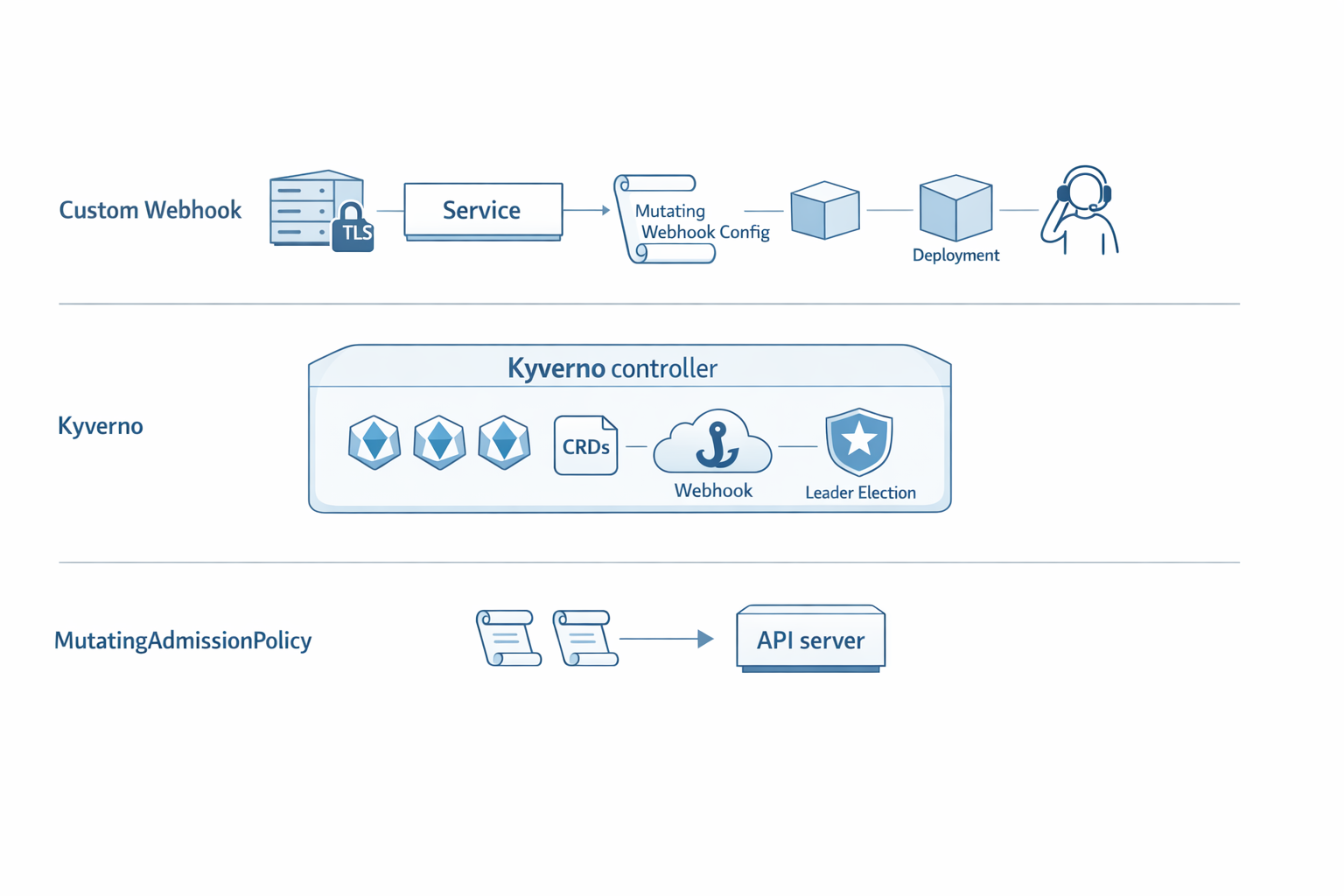
When does each option make sense? In rough order of weight:
- MutatingAdmissionPolicy. Simple, declarative mutations that can be expressed as a CEL expression over the incoming object. Injecting tolerations, default labels, default resource requests, basic sidecars, environment overrides. As of 1.36 this is the default starting point. It is the cheapest option that does the job.
- Kyverno (or Gatekeeper, or OPA). When you have a real policy program. Many policies under one roof, validation plus mutation plus generation, image verification, policy reports, scheduled background scans, policy exceptions as first-class objects, multi-tenant policy delegation. If you are reaching for any of those, the controller overhead pays for itself.
- Custom webhook. When you need to consult external state. A SaaS lookup, a database, an ML model, a remote config service. MutatingAdmissionPolicy is CEL-only, and CEL has no I/O by design. Anything that needs to look outside the request object needs a webhook.
The split is along a clear line. CEL-expressible mutations live in MutatingAdmissionPolicy. Multi-feature policy programs live in Kyverno (or peers). External state lookups live in a custom webhook. The hard part used to be that the first bucket did not exist, so even tiny mutation rules paid the webhook tax.
⏭️ What’s Next ⏭️
The next several KUDD posts will keep pulling on threads we just brushed against:
- Server-side apply vs client-side apply, field managers, and conflicts
- How does
kubectl port-forwardactually work? (SPDY/websockets) kubectl wait, watches, and why--waitbeatssleep- JSONPath, custom-columns, and other output sorcery
ValidatingAdmissionPolicy, the sibling of today’s feature, and how validating and mutating compose
🏠 Take Home Points 🏠
- Admission control runs between authz and persistence. Mutating admission can change the object on the way in. Validating admission can reject it.
- Until 1.36, declarative mutation meant a custom webhook (a real workload with real operational weight) or a full policy engine like Kyverno (overkill for simple cases).
- 1.36 GA’s
MutatingAdmissionPolicyandMutatingAdmissionPolicyBinding. Write a CEL expression, scope it with a binding, done. The API server handles it in-process. - CEL has no I/O by design. That is a feature: predictable evaluation, no extra workload, no availability story to manage.
- When you need external state, keep the webhook. When you need a full policy program, keep Kyverno. For everything in between,
MutatingAdmissionPolicyis the new default.
If you enjoyed this post, check out my book on running Kubernetes at scale:
🇻🇦 Vale, amici! 🇻🇦